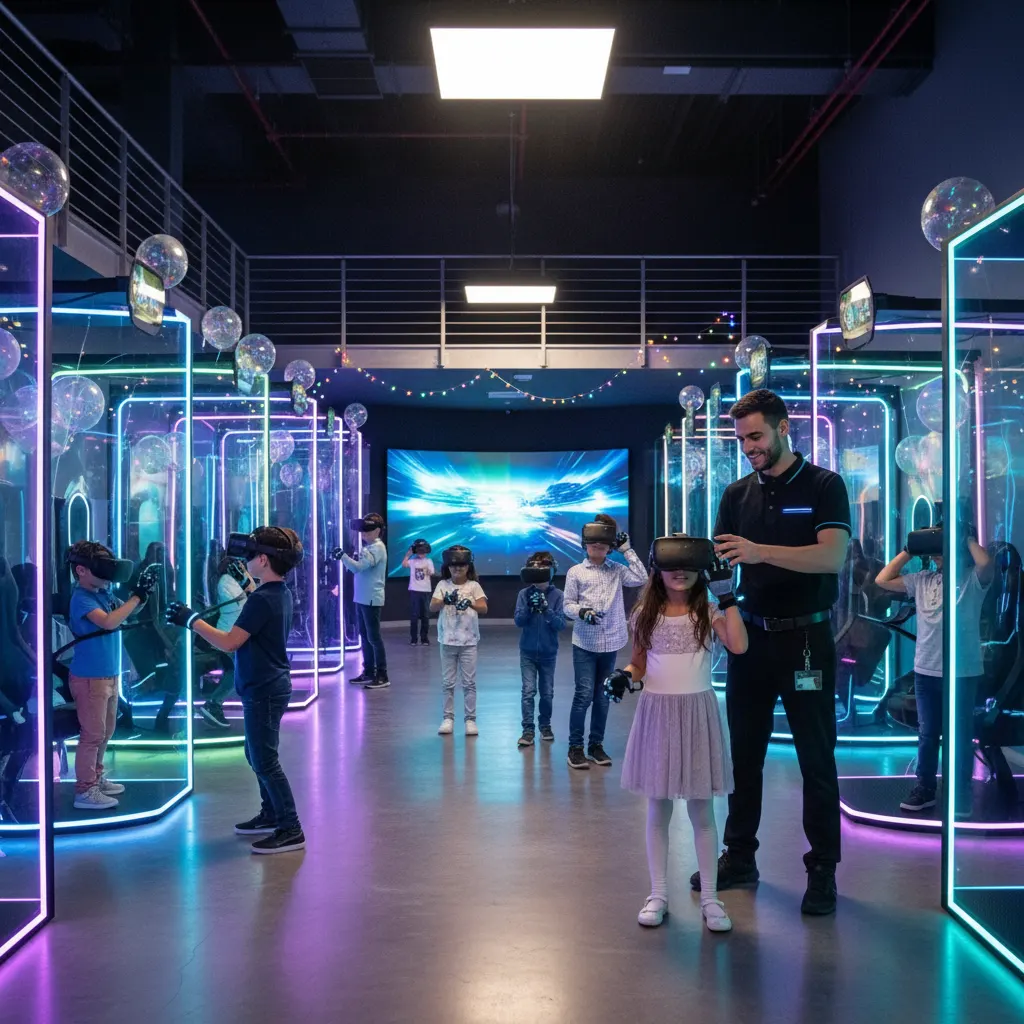
Birthday party VR ideas are themed activities that use virtual reality to create interactive celebrations. In London, Ontario, families and friends can book immersive sessions at The Next Level’s VR arcade to mix games, challenges, and team play into a stress-free, high-energy birthday plan that keeps guests engaged from arrival to cake-cutting.
By The Next Level • Last updated: 2026-04-19
Quick Summary & Table of Contents
Plan a VR birthday by choosing a party format (pods, multiplayer, or escape room), setting a guest flow, and prepping quick-switch games for different ages. Build a 2–3 hour schedule, rotate players in 10–20 minute bursts, and use the party room for cake, gifts, and spectating between turns.
Throwing a VR birthday party should be exciting, not chaotic. This complete guide blends hands-on planning steps with real examples from our London arcade so you can deliver a smooth, memorable event for kids, teens, or adults—first-timers and gamers alike.
- What a VR birthday party is and why it works
- Step-by-step schedule templates for 2–3 hours
- Pods vs. escape rooms vs. free-roam multiplayer
- 21 creative birthday party VR ideas to steal today
- Best practices for mixed ages and skill levels
- Safety, accessibility, and comfort tips
- Local considerations for London hosts
- FAQ, key takeaways, and next steps
What is a VR birthday party?
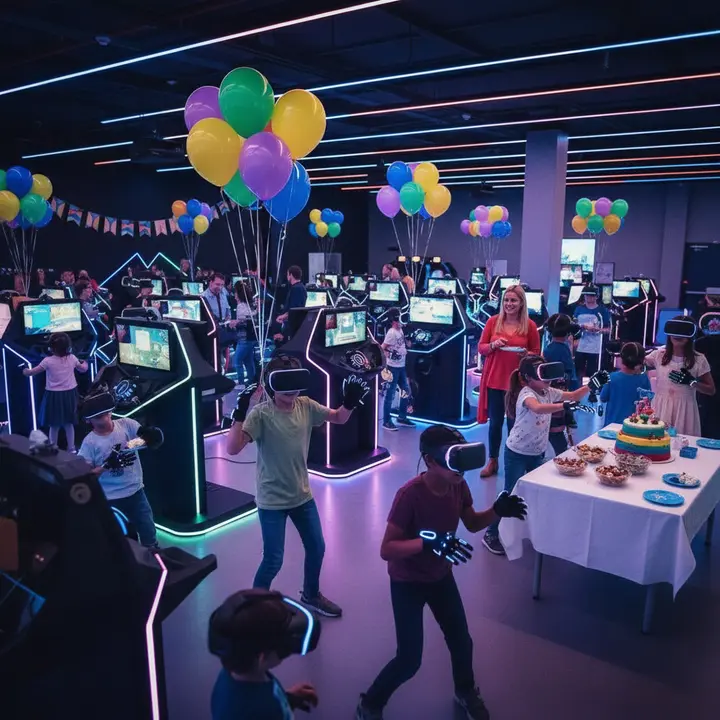
A VR birthday party is a celebration built around virtual reality gameplay, where guests rotate through immersive experiences that fit different ages and skill levels. At a modern arcade, you’ll reserve gaming pods or a VR escape room, organize short play intervals, and use a lounge space for cake, gifts, and spectating.
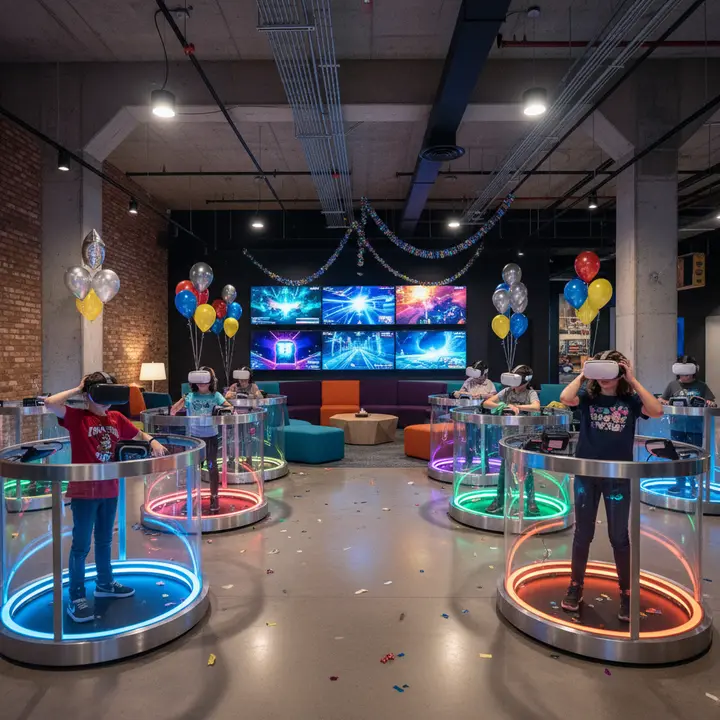
A virtual reality birthday centers on shared moments—shouts, laughs, and problem-solving—created by headsets, room‑scale tracking, and motion controllers. At The Next Level in London, Ontario, groups use 22 gaming pods and 12 themed VR escape rooms to keep energy high and downtime low, while large screens let non-players cheer on the action.
- Immersion without complexity: Our team sets up headsets, calibrates room‑scale tracking, and helps guests hop between titles fast.
- Flexible formats: Personal pods for solo or co-op play, or escape rooms for structured team puzzles.
- All ages, all interests: From creative sandboxes to high-energy wave shooters and family-friendly adventures.
Why VR birthday parties work for kids, teens, and adults
VR parties work because they combine novelty, movement, and teamwork into a compact, easy-to-run format. With short game rounds, spectators can watch on TVs, guests stay active between turns, and groups naturally rotate—so attention stays high and the host isn’t juggling logistics all afternoon.
Novelty drives engagement. A fresh game library means birthday guests rarely repeat the same experience twice. The Next Level maintains 22 pods and 12 escape rooms, so larger groups can spread out. Structured rotations—10–20 minutes—keep excitement high and motion comfort steady for first‑timers.
- Built-in variety: Action, creative, educational, and multiplayer titles let you match content to each guest.
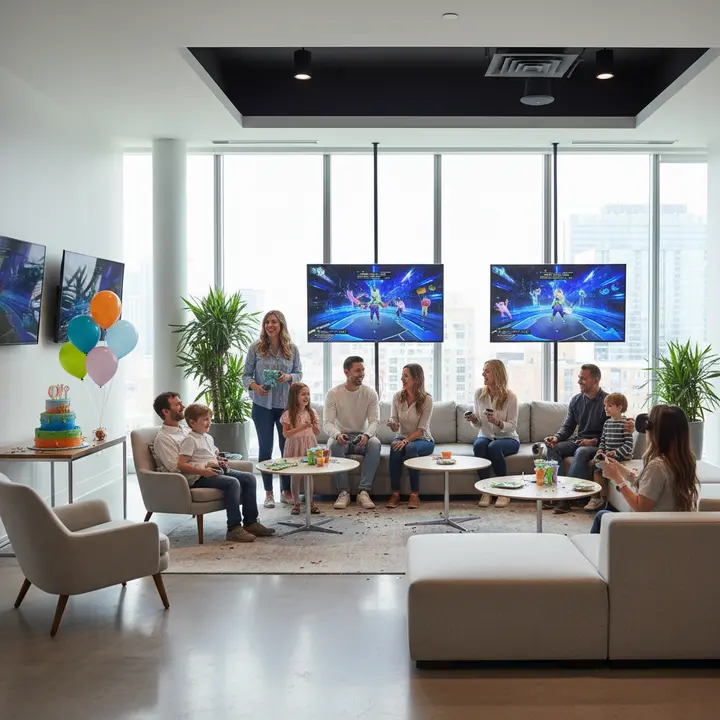
- Social viewing: Large screens let everyone follow the in‑game story, which fuels cheering, photos, and inside jokes.
- Team dynamics: Escape rooms support 1–6 players per session; pods support solo and co-op modes for flexible pairing.
- Structured pacing: Short, repeated rounds reduce fatigue and make it easy to include cake, gifts, and breaks without losing momentum.
In our experience hosting London families, the best parties blend quick wins (easy starter games) with 1–2 “wow” moments—like a finale escape-room challenge or a friendly multiplayer showdown. That balance keeps newcomers confident and seasoned gamers satisfied.
How a VR birthday party works (step-by-step)
Book your VR spaces, plan a 2–3 hour flow, and run 10–20 minute rotations. Start with easy, comfort-first games, then anchor the event with a co-op challenge or escape room. Use a private lounge for cake, gifts, and spectating so non-players stay engaged between turns.
Here’s the party framework we use daily at our London arcade. Adapt durations to your group size, guests’ ages, and how many players are in pods versus a VR escape room.
- Reserve your setup: Choose personal pods, a VR escape room, or both.
- Build your roster: Confirm headcount, age mix, and any accessibility needs.
- Plan your rotations: 10–15 minutes for starter games; 15–20 minutes for featured titles.
- Pick a theme: Adventure, sci‑fi, creative art, or puzzle-solving.
- Curate 6–10 games: Mix beginner-friendly, co‑op, and one “boss-level” finale.
- Set a simple schedule: Arrival (10), Warm-up (20), Main play (60–90), Cake + gifts (20), Finale (20), Photos (10).
- Stage the party room: Use lounge seating and TVs for viewing and group photos.
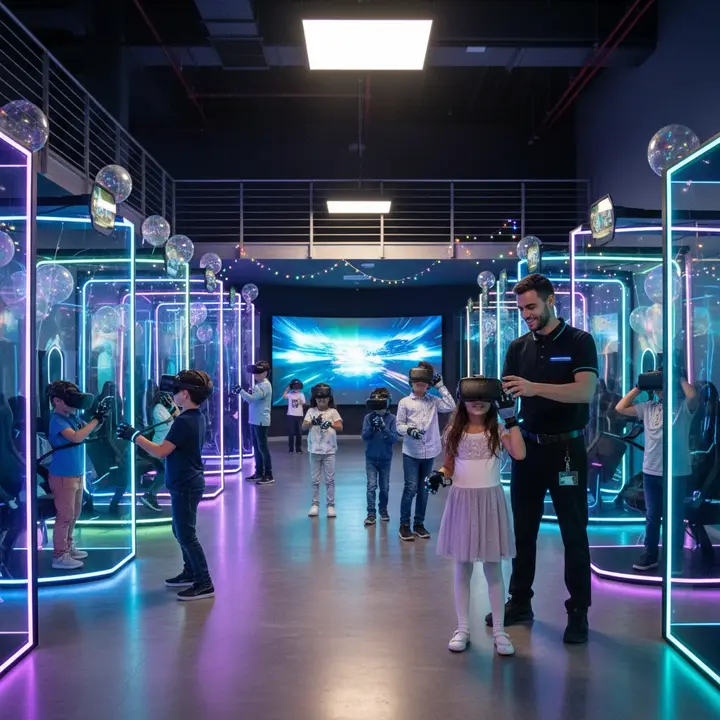
- Prep helpers: Assign one adult or teen as the “switch captain” to help guests trade headsets smoothly.
- Warm-up brief: Comfort tips, headset fit, controller basics, and a 30‑second motion check.
- Run the show: Keep the queue visible, call out next players, and bookmark your finale.
| Segment | Duration | Goal | Games/Notes |
|---|---|---|---|
| Arrival + Setup | 10 min | Check-in, waivers, fit headsets | Quick demo on controllers and play-area boundaries |
| Warm-up Round | 20 min | Build comfort, early wins | Beginner titles; no timers or high pressure |
| Main Play | 60–90 min | Variety + highlights | Rotate 6–8 games across pods; stagger difficulty |
| Cake + Gifts | 20 min | Social reset, photos | Use party room TVs to replay clips or show live play |
| Finale Challenge | 20 min | Shared “wow” moment | Team escape-room puzzle or friendly multiplayer showdown |
| Photos + Wrap | 10 min | Memories + goodbyes | Group photo, leaderboard shout-outs |

Pro tip: For sharper pacing, plan two queues: one for pods (solo/duo) and one for your finale experience. That way, your “endgame” starts on time even if early rounds run long.
Types of VR birthday formats (pods, escape rooms, multiplayer)
Choose between personal gaming pods for variety, VR escape rooms for structured teamwork, or a hybrid that mixes both. Pods are best for rapid rotations and mixed ages; escape rooms deliver an unforgettable shared story for 1–6 players; hybrids balance freedom with a climactic group finale.
The Next Level’s capacity—22 pods plus 12 escape rooms—lets you tailor the day to your guest list. Think in formats, not only in game titles. That makes it easier to serve different ages and skills while keeping everyone on schedule.
Personal gaming pods
- Great for variety: Guests bounce between action, creative, and multiplayer games.
- Ideal rotation length: 10–15 minutes for warm-ups; 15–20 for featured games.
- Spectator-friendly: TVs show what each player sees in-headset.
VR escape rooms
- Team storytelling: 1–6 players collaborate through puzzles and set pieces.
- Natural finale: Time-limited missions raise energy and focus.
- Beginner inclusive: Roles can be split so first‑timers contribute without pressure.
Hybrid party flow
- Pods first, escape room last: Build comfort, then finish with a cooperative challenge.
- Escape room first, pods later: Kick off with a shared story, then let guests free-roam.
- Pods-only marathon: Use curated stations (creative, action, co‑op, “photo booth”).
Want format inspiration tailored to London families? Our overview on the local scene highlights capacity and options across pods and rooms—see the VR arcade London overview for context on group sizes and pacing.
21 birthday party VR ideas (kid, teen, and adult-friendly)
Build your party around themes like “Creative Lab,” “Space Adventure,” or “Beat the Boss.” Pair short, confidence-building games with one signature challenge. Use stations—creative, action, co‑op, photo booth—so guests can bounce between experiences without waiting long.
These ideas work well with 22 pods and 12 escape rooms available in our London venue. Mix and match based on age, energy, and how many players you can run at once.
- Creative Lab: 3D painting, sculpting, and virtual photography; save screenshots for party favors.
- Space Adventure: Planet hopping, asteroid dodging, and zero‑G puzzles.
- Beat the Boss: A finale showdown against a hulking VR enemy with spectators hyping the player.
- Time-Travel Quest: Solve puzzles across eras; escape room as the capstone.
- Family Co‑Op Night: Pair kids with adults in supportive co‑op challenges.
- Sports & Fitness: Rhythm boxing, target ranges, and dodge challenges.
- Mini-Games Gauntlet: 60-second trials across 10 pods; post scores on a whiteboard for fun.
- Haunted Mystery: Puzzle your way through spooky environments; finish with a team escape.
- Build-A-World: Collaborative sandbox; name landmarks after the birthday guest.
- Speedrunner Circuit: Who can clear the level fastest? Rotate 10-minute attempts.
- Arcade Classics Reborn: Retro-inspired targets and waves, now in room‑scale VR.
- Photo Booth Pod: Stage comedic poses or in‑game snapshots for a highlight reel.
- Teachers vs. Students: Great for school groups—friendly, respectful competition.
- Sibling Spotlight: Pair younger siblings with teen “coaches” for confidence.
- Science & Nature Tour: Interactive learning through worlds and wildlife.
- Rhythm Night: Music-driven swings and dodges with a crowd-pleasing playlist.
- Boss-Rush Ladder: Increasing difficulty; tag-in teammates when tired.
- Creators’ Showcase: Guests present quick demos of what they built in creative stations.
- Escape the Ship: A multi-room VR escape where each teammate owns a role.
- Parents’ Play Round: Let adults take a turn—kids love cheering them on.
- Leaderboard Awards: End with “Most Creative,” “Best Team Save,” and “Clutch Moment.”
For puzzle-forward groups, we’ve compiled fast, fair strategies—see our guide to VR escape room tips for planning your finale challenge and keeping every role meaningful.
Best practices to host a smooth VR birthday (from our London team)
Keep games short, rotate often, and start with comfort-first titles. Assign a switch captain, brief on headset fit, and reserve a lounge for cake and spectating. Curate games by age and skill, then anchor the party with a shared co-op or escape-room finale.
After thousands of guest sessions, we’ve found consistent levers that make birthday events shine in London, Ontario. Use this checklist while you plan.
- Comfort-first onboarding: Fit the headset, teach boundaries, and do a quick “look-turn-move” drill.
- Age‑aware curation: Pair younger players with slower movement and clear objectives; teens crave challenge and speed.
- Two-queue method: Run pods and your finale on separate tracks so endgame timing stays firm.
- Role cards: Navigator, Clue Keeper, and Spotter help non‑players stay engaged during escape rooms.
- Photo moments: Save screenshots; plan a 5‑minute “Creators’ Showcase” for art stations.
- Hydration & breaks: Schedule a reset between main play and the finale to reduce fatigue.
- Accessibility: Offer seated options and adjustable movement settings as needed.
- Noise management: Keep the room lively but make space for clear comms during team challenges.
Local considerations for London
- Weekend demand spikes: birthdays, team socials, and school breaks fill fast—finalize your headcount early to secure ideal time slots.
- Winter and early spring: plan for coats and boots; arrive 15 minutes early so guests can stash gear and start on time.
- Mixed-age groups are common: set one creative pod, one action pod, and one co‑op pod to reduce wait times during busy hours.

Plan with confidence: For a deeper look at capacity, formats, and rotation ideas in our city, explore the concise VR arcade London overview—handy when building your guest flow.
Tools, resources, and templates
Use a one-page run-of-show, a rotation board with 10–20 minute slots, and a curated game list by age and theme. Prep a comfort checklist, role cards for escape rooms, and a quick photo plan so you capture highlights without slowing play.
Tools help you host without scrambling. Most parties run best with preprinted rosters and simple station labels, plus a short comfort script for first‑timers.
- Run-of-show template: Arrival, Warm-up, Main Play, Cake + Gifts, Finale, Photos.
- Rotation chart: Names down the left; 10–20 minute blocks across the top.
- Game curation sheet: Tier titles by beginner, intermediate, and challenge.
- Escape-room role cards: Navigator, Clue Keeper, Communicator, Spotter.
- Photo checklist: “First high five,” “Creators’ Showcase,” “Finale win pose.”
- Comfort script: “Lift headset gently, keep feet centered, use gentle head turns before moving.”
Hosting at a professional VR arcade simplifies logistics even further—our team in London handles calibration, safety checks, and quick swaps, so you can focus on guests.
Mini case studies: what works in the real world
Successful VR birthdays balance quick wins with one signature moment. Start with easy games to build confidence, then aim all eyes at a finale—either a team escape or a friendly multiplayer bout. The right pacing turns a 2–3 hour window into nonstop highlights.
Elementary birthday (ages 8–10)
We set one creative station and one simple action station. Kids rotated in 10-minute bursts, earning stickers for “Creative Build” and “Team Save.” The finale was a beginner-friendly escape-room puzzle where every child held a role card. Photos and cake in the lounge wrapped the day.
Teen party (ages 13–15)
Teens started with rhythm and sports, then shifted to a speedrun circuit. Main play ran 75 minutes across six pods. Finale was a co‑op challenge with a running timer on the TV. A “Clutch Moment” award went to the fastest rescue.
Family-and-friends social (mixed ages)
We split into two queues: pods for free-roam variety and a finale escape room. Adults paired with kids during warm-ups; teens ran the scoreboard. Lounge seating kept grandparents involved as sideline coaches.
Safety, comfort, and accessibility essentials
Safety starts with a comfort check, correct headset fit, and clear play-area boundaries. Keep first sessions short, encourage gentle head turns, and offer seated options when helpful. A quick reset between main play and the finale maintains energy and reduces fatigue.
Our London team emphasizes predictable rhythms and easy wins. Room‑scale boundaries prevent collisions and staff monitor spacing between pods. Guests who prefer seated experiences can still enjoy creative titles, narrative adventures, and turn-based puzzles.
- Fit first: Adjust straps and interpupillary distance; confirm clear visuals.
- Boundaries: Review chaperone grids and “stay centered” habits.
- Short starts: First 5 minutes should be simple movements and slower visuals.
- Hydrate + breathe: Schedule a mid-party reset—even 5 minutes helps.
- Seated modes: Great for creative apps, rhythm games, and many puzzles.
- Staff support: Attendants guide calibration, swaps, and troubleshooting.
If you love puzzle teamwork, take five minutes with these practical VR escape room tips—quick wins for role clarity and time management.
How to choose games for different ages and skills
Match games to attention span and comfort. Young kids thrive on creative and clear-goal titles; teens prefer competitive or fast-paced challenges; adults often enjoy co‑op problem solving. Build a list of 6–10 games that escalate difficulty across the party timeline.
The Next Level curates a massive, frequently updated library that spans action, creative, educational, and multiplayer genres. This makes it easy to tailor parties without overthinking the tech.
- Ages 7–9: Creative sandboxes, friendly targets, short adventures.
- Ages 10–12: Co‑op quests, light puzzles, playful action.
- Teens: Rhythm gauntlets, competitive arenas, team escapes.
- Adults: Narrative co‑op, strategy puzzles, party-friendly sports.
For multiplayer pacing and sportsmanship at a birthday, skim our concise multiplayer VR tips—great for setting ground rules and tournament formats.
Frequently asked questions
Most hosts ask about age ranges, group sizes, motion comfort, and how to mix game types. Start simple, rotate often, and finish with a shared challenge. Reserve enough pods or a room to keep wait times low and energy high throughout the party.
What ages are best for a VR birthday party?
VR parties work well for kids, teens, and adults. For younger guests, choose creative or guided experiences with simple objectives. Teens often prefer competitive or speedrun-style games. Mixed-age groups do best with a mix of creative pods and a co‑op or escape-room finale.
How many people can play at once?
Capacity depends on how many pods or rooms you reserve. At our London arcade, there are 22 individual pods for solo or co‑op play and 12 themed VR escape rooms for 1–6 players per session. We’ll help you set rotations so everyone gets multiple turns.
How do you prevent motion sickness for first‑timers?
Start with comfort-first titles, encourage gentle head turns, and keep the first round short. Proper headset fit and clear play-area boundaries help a lot. Offer seated options for guests who prefer them, and plan a mid-party break before your finale challenge.
What’s the best way to schedule a 2–3 hour party?
Use a simple run-of-show: Arrival (10), Warm-up (20), Main Play (60–90), Cake + Gifts (20), Finale (20), Photos (10). Keep rotations to 10–20 minutes, assign a switch captain, and anchor the event with one shared co‑op or escape-room challenge.
Key takeaways and next steps
The best VR birthdays combine short, beginner-friendly rounds with one shared finale. Reserve the right mix of pods and rooms, rotate guests every 10–20 minutes, and keep spectators engaged with TVs and a cozy lounge. A simple run-of-show turns a busy afternoon into lasting memories.
- Choose a format: Pods, escape room, or hybrid flow.
- Curate 6–10 games: Start easy, end epic.
- Run rotations: 10–20 minute slots keep energy high.
- Use a lounge: Cake, gifts, and great photos without pausing play.
- Finish together: A team finale locks in the memory.
Ready to plan? For a quick orientation to space, formats, and pacing, browse our local VR arcade London overview before you build your guest flow.