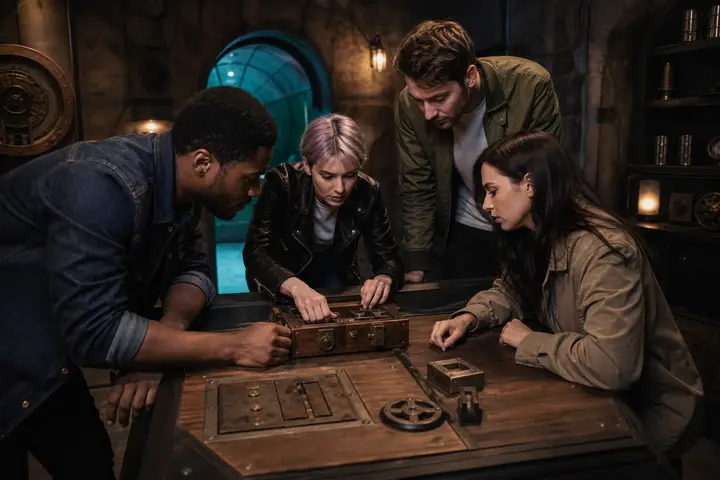
Looking for a family friendly escape room that keeps kids engaged, challenges teens, and still entertains adults? The best choices balance safety, clear puzzle logic, and age‑appropriate themes with just the right level of challenge. Use this guide to choose confidently, prepare your group, and set everyone up for a memorable experience.
What makes an escape room family friendly?
“Family friendly” isn’t a single feature — it’s a mix of elements that work together for different ages, attention spans, and comfort levels. When evaluating options, look for:
- Age-appropriate themes: Adventurous, whimsical, or mystery-forward stories that avoid gore and intense horror tones.
- Clear puzzle logic: Clues that reward observation and collaboration rather than niche trivia. Kids should be able to contribute meaningfully.
- Comfortable environments: Adequate lighting, manageable sound levels, and spaces that feel welcoming rather than claustrophobic.
- Flexible hint systems: Friendly, responsive hints help keep momentum and morale up for mixed-skill groups.
- Safety-first hosting: Briefings that cover rules, emergency procedures, and respectful play help new participants feel at ease.
Rooms designed with families in mind typically emphasize story clarity, intuitive progression, and teamwork over raw difficulty or fear-based thrills.
Picking the right difficulty
Difficulty can make or break the fun. Too hard, and the experience stalls; too easy, and older players feel under-stimulated. Consider:
- Published difficulty tiers: Many escape rooms label experiences from beginner to expert. For mixed ages or first-timers, beginner to intermediate is most forgiving.
- Success rate context: A moderate success rate often signals accessible puzzles with just enough bite.
- Hint culture: Friendly, on-demand hints let families tune the challenge in real time.
When in doubt, aim one notch easier than you think you need for your first family outing. You can always level up next time.
Themes to please mixed ages
Families tend to enjoy themes with broad appeal and uplifting stakes. Consider the following crowd-pleasers:
- Adventure quests: Treasure hunts, jungle expeditions, and ancient temple mysteries offer universal excitement without leaning on fear.
- Whodunit mysteries: Detective cases and clever capers invite observation, note-taking, and collaborative deduction.
- Science and exploration: Spaceships, time labs, and museum-style puzzles connect naturally to curiosity and learning.
- Fantasy and magic: Enchanted libraries or wizard workshops encourage creative thinking and playful immersion.
If your family includes very young players, scan the room description for any caution notes about darkness, jump scares, or intense audio. Even mild spookiness can feel bigger to kids in an unfamiliar setting.
Safety and accessibility checks
Family friendly escape rooms balance immersion with clear safety and accessibility. Before you book, look for or ask about:
- Pre-briefing: A clear explanation of rules, emergency exits, and how to request assistance.
- Physical access: Entry width, seating availability, and whether tasks require crawling, climbing, or tight spaces.
- Sensory notes: Lighting levels, strobe effects, loud audio, or fog that may affect sensitive participants.
- Reset and cleanliness standards: Tidy props and well-maintained locks prevent frustration and encourage confident exploration.
- Staff monitoring: Operators who can observe and support without disrupting immersion.
When accessibility matters for your group, reach out in advance with specific questions so you know exactly what to expect.
Group size and time planning
Right-sizing your group helps everyone stay engaged. Consider:
- Recommended headcount: Many rooms are designed for small teams. Fewer people means more hands-on time per player.
- Role variety: Rooms with parallel puzzles let siblings or cousins split tasks and avoid bottlenecks.
- Session length: Standard sessions usually run about an hour. Shorter options can be friendlier to younger attention spans.
Balance social energy against puzzle density. If your family loves to chatter and joke, a slightly smaller team can keep the room from feeling crowded.
Preparing kids and first-timers
A little preparation builds comfort and confidence — especially for puzzle newcomers. Try these steps:
- Set the tone: Explain that it’s a cooperative game where you search, share, and try ideas. Emphasize that hints are part of the fun, not “cheating.”
- Practice micro-skills: Quick family warm-ups — word scrambles, matching patterns, or observation games — prime problem-solving muscles.
- Assign light roles: Younger kids can be clue collectors or symbol spotters; older kids might track locks, codes, or story beats.
- Normalize unknowns: Not every clue will click immediately. Celebrate experiments, not just solutions.
Remind everyone that momentum matters more than perfection. Progress in escape rooms is often non-linear — small discoveries add up.
VR vs. physical escape rooms
Today, many families consider both traditional rooms and virtual reality (VR) escape room experiences. Each offers distinct advantages:
- Physical rooms: Tangible props, locks, and set pieces satisfy hands-on learners and make it easy for kids to help find hidden items.
- VR experiences: Immersive worlds unlock scenarios that are hard to stage physically — think zero-gravity spaceships or time-bending puzzles — while still emphasizing teamwork and communication.
For families, the choice often comes down to comfort with headsets, motion preferences, and the types of stories that excite your group. If you’re curious but new to VR, look for venues that provide clear guidance on headset fit, controls, and in-experience communication so everyone can participate smoothly.
Maximizing teamwork and fun
Great family sessions feel collaborative from start to finish. Use these quick habits to keep energy high and everyone involved:
- Rotate tasks: Swap roles every few minutes so no one gets stuck or sidelined.
- Log your progress: Keep a simple note of tried codes, symbols seen, or puzzles opened. This prevents wheel-spinning.
- Call for hints early: If you stall for more than a few minutes, a nudge can unlock momentum and keep morale high.
- Celebrate small wins: Recognize effort and clever thinking, not just the final door opening.
Teams that communicate freely and adapt quickly tend to have the most fun, regardless of the final timer.
Budgeting and booking questions to ask
Before you commit, clarify a few practical details so there are no surprises on the day:
- Private vs. shared bookings: Some experiences are private, while others may pair small groups together.
- Age guidance: Ask about recommended ages and any supervision requirements for minors.
- Duration and buffer times: Confirm the experience length and any pre-briefing or debrief time windows.
- Rescheduling policies: Plans change with kids. Understand how to adjust your booking if needed.
- Parking and arrival: Aim to arrive early enough for check-in and instructions, especially with first-timers.
Clear expectations make it easier to focus on the fun — and to pivot gracefully if your group needs an easier room or extra guidance.
Day-of checklist for a smooth experience
Use this short checklist to keep your session stress-free and enjoyable:
- Arrive early enough for check-in, briefings, and restroom breaks.
- Hydrate and have a light snack beforehand; avoid heavy meals right before the session.
- Wear comfortable clothing and closed-toe shoes; bring glasses if needed for reading fine print.
- Secure long hair and remove loose jewelry that might snag on props or headsets.
- Review basic rules as a group: be gentle with props, communicate, and ask for hints when needed.
- Designate a simple team system for tracking clues (e.g., one notetaker, one organizer of found items).
Small, thoughtful steps before the clock starts help everyone relax and participate fully.
FAQ: family friendly escape room basics
How young is too young for a family friendly escape room?
It depends on the specific experience and your child’s comfort with new environments. Many family-oriented rooms welcome school-age kids who can follow instructions and enjoy searching for clues. Check the venue’s guidance on age appropriateness and supervision to choose a good fit.
Are escape rooms educational for kids?
They can be. Many puzzles encourage observation, pattern recognition, communication, and basic logic. Treat the experience as a collaborative problem-solving activity where each family member contributes unique strengths.
How do VR escape rooms handle teamwork if everyone wears headsets?
In VR experiences designed for groups, communication tools and shared objectives let teams coordinate just like in a physical room. As with any escape game, calling out discoveries and assigning roles keeps everyone in sync.