
Family friendly VR games are age-appropriate virtual reality experiences built for kids, teens, and adults to enjoy together. They focus on cooperative play, comfort settings, and easy-to-learn controls. In London, Ontario, The Next Level curates these titles across 22 pods and 12 VR escape rooms, so your crew can jump in fast and have fun safely.
By The Next Level • Last updated: 2026-04-28
Start Here: Your family VR game plan
Plan a great family session by choosing kid-safe genres, enabling comfort options, and starting with 30–60 minute blocks. At The Next Level in London, Ontario, 22 gaming pods and 12 escape rooms make it easy to mix ages and skill levels, switch games quickly, and keep everyone engaged.
Here’s the fast path to a smooth, low-stress visit that fits families with mixed ages, interests, and VR experience levels.
- Pick the right genres: Creative, puzzle, rhythm, and sports titles are easy wins for first-timers.
- Use comfort features: Snap-turn, teleport, seated modes, and vignette help reduce motion discomfort.
- Think in short blocks: Younger kids tend to thrive in 15–20 minute rounds within a 30–60 minute session.
- Go social: Choose co-op games first, then add light competition once confidence builds.
- Leverage our staff: Our team helps configure headsets, launch games, and suggest difficulty for every age.
Quick Summary
Family friendly VR games emphasize cooperation, gentle challenge, and comfort-first design. For best results, match genres to ages, schedule short play blocks, and use built-in safeguards. The Next Level’s 4,000+ square feet, 22 pods, and 12 escape rooms let families rotate players, spectate, and learn together.
- What you’ll learn: Definitions, age-fit genres, comfort settings, and step-by-step planning tips.
- Why it matters: You’ll avoid common hurdles like motion discomfort or skill gaps between ages.
- Where to play: Our VR arcade in London offers 22 pods, 12 escape rooms, and a private party room.
- Extras: See educational VR experiences for school-friendly content.
Local considerations for London
- Weeknight flexibility: London families often find more open pods on weekday evenings, which makes it easier to seat a group together in adjacent pods.
- Seasonal timing: During school breaks and holidays, consider reserving earlier in the day so younger kids can play before peak evening crowds.
- Group mix: Our 1–6 player VR escape rooms are ideal when your group includes different ages; pair confident teens with adults, and let younger kids spectate between quick turns.
What are family friendly VR games?
Family friendly VR games are age-suitable virtual reality titles that favor cooperative play, gentle difficulty curves, and comfort-first movement. They help kids, teens, and adults play together by using simple controls, adjustable settings, and short, replayable challenges that fit 30–60 minute sessions.
At their core, these games blend accessibility with depth. Parents can join kids without feeling lost, and skilled teens still find challenges. Many favorites support co-op or asynchronous play so everyone participates—whether wearing a headset, watching on a TV, or calling out clues.
- Common traits: Clear objectives, helpful tutorials, forgiving fail-states, and adjustable difficulty.
- Movement types: Teleport, snap-turn, seated modes, and vignettes to reduce motion discomfort.
- Session fit: Designed for short, satisfying wins inside 30–60 minute windows.
- Social design: Spectator screens and shared roles keep siblings and parents engaged.
At The Next Level, our 22 pods let families spread out or cluster closely for shared viewing. With 12 VR escape rooms, 1–6 players can tackle puzzles, pass clues, and rotate leaders so everyone gets a turn.
Why family friendly VR matters
Family-friendly VR matters because it creates safe, shared play across ages. With 22 pods, 12 escape rooms, and staff-guided setup, The Next Level helps parents reduce motion discomfort risks, balance difficulty, and keep kids engaged through short, cooperative challenges.
Families often span ages 6 to 60+. VR can unite them if the content and setup are right. The right configuration reduces friction for newcomers and gives confident players real goals.
- Shared wins build confidence: Co-op tasks let younger kids contribute ideas and celebrate progress.
- Fast onboarding: Clear tutorials, simple inputs, and our staff support speed up the first 10 minutes.
- Balanced challenge: Adjustable difficulty and puzzle hints prevent frustration.
- Healthy pacing: Break-friendly design and 15–20 minute rotations keep energy high.
Our private party room—with lounge seating and large TVs—turns gaming into a group event. Parents can watch on big screens, coach from the couch, and take photos while kids earn achievements.
How family VR works at The Next Level
Families choose pods, pick co-op titles, and enable comfort settings. Staff fit headsets, explain controls, and suggest age-appropriate modes. With 22 pods and a 4,000+ sq ft floor, groups can rotate players, spectate on TVs, and switch genres without losing momentum.
When you arrive, our team sizes headsets, adjusts interpupillary distance (IPD), and calibrates room-scale boundaries. For first-time families, we start with a tutorial or a creative sandbox so everyone can learn buttons and gestures quickly.
- Pick your layout: Place siblings in adjacent pods for easy coaching and cheering.
- Start simple: Try creative or rhythm before action or physics-heavy games.
- Use co-op roles: One player explores while another solves clues from the TV view.
- Rotate every 15–20 minutes: Keeps kids fresh and curious while adults pace the session.
Our game library includes action, creative, educational, and multiplayer titles—and we update it continuously. If your group has 1–6 players, our 12 VR escape rooms offer a guided path to collaboration with built-in hint systems and clear objectives.
Types of family friendly VR games
The best family VR picks include creative sandboxes, puzzle adventures, rhythm and music games, cooperative party games, and light sports. These genres teach core skills fast, support spectators, and scale difficulty so mixed-age groups can succeed together.
Creative and building
- Why it works: Zero-pressure exploration encourages kids to learn controls without fear of failure.
- What to expect: Painting, sculpting, world-building, and museum-like discovery.
- Family tip: Pair a builder with a “director” watching on TV who requests new ideas.
Puzzle and escape adventures
- Why it works: Clues, patterns, and logic give every age a way to participate.
- What to expect: Object interactions, code-breaking, and environment scanning.
- Family tip: Rotate the “lead solver” every puzzle; let observers track clues on paper.
Want deeper puzzle strategies? Our guide on VR escape room clues shows how to organize roles, communicate clearly, and beat the clock as a team.
Rhythm and music
- Why it works: Quick feedback loops, satisfying beats, and natural movement.
- What to expect: Slashing, drumming, or dancing—great for 10–15 minute bursts.
- Family tip: Alternate songs and difficulties to keep everyone included.
Party co-op and light competition
- Why it works: Short rounds, fun chaos, and lots of laughter—ideal with cousins and grandparents.
- What to expect: Mini-games, goofy physics, and shared objectives.
- Family tip: Keep score on the lounge TV and crown a “good-sport” winner.
Sports and active play
- Why it works: Familiar rules plus lightweight motion make it approachable.
- What to expect: Bowling, table tennis, archery, and casual target games.
- Family tip: Pair a player with a coach; switch roles after each round.
Best practices for parents and guardians
Set your group up for success by using comfort features, matching difficulty to age, rotating turns every 15–20 minutes, and celebrating shared wins. At The Next Level, staff guide setup, suggest kid-friendly modes, and help you switch games quickly.
In our experience hosting thousands of family sessions in London, three patterns consistently predict a great visit: comfort-first setup, role-based teamwork, and short, high-energy rounds.
- Comfort-first: Enable teleport, snap-turn, vignette, and seated modes for newcomers.
- Role-based teamwork: Assign “navigator,” “puzzle-solver,” and “spotter” so spectators stay engaged.
- Short rounds: Keep kids excited with 10–15 minute game chunks inside a 30–60 minute session.
- Hydrate and break: Water and two-minute stretch breaks can reset focus quickly.
- Celebrate progress: Use mini-goals; post-session, check your scores on our VR leaderboard.
Tip: If you’re planning a birthday, our lounge-style party room keeps everyone together with large TVs for shared viewing and photos.

Tools, resources, and tech that help
High-end headsets, room-scale tracking, and simple controllers make family play smoother. The Next Level uses HTC Vive Pro with motion controllers across 22 pods, plus large spectator TVs and 12 guided escape rooms so families can teach, watch, and cheer together.
Hardware matters when you’re onboarding multiple ages in minutes. Reliable tracking and clear optics reduce friction so you can focus on play, not setup.
- Room-scale tracking: Our pods define safe boundaries and let kids move naturally.
- Motion controllers: Intuitive grip/trigger mapping shortens the learning curve.
- Spectator screens: Big TVs in the party room make coaching and celebrating easier.
- Library depth: A continuously updated catalog means fresh options every visit.
- Staff support: Quick demos, headset fitting, and voice-of-experience recommendations.
New to VR and want a gentle start? Read our VR arcade beginner tips before you arrive. You’ll learn comfort settings, controller basics, and how to ease kids into their first 10 minutes.
Planning your family session step by step
Match people to pods, choose two genres, and schedule rotations. Start with a tutorial or creative title, then switch to a co-op puzzle or rhythm game. Keep rounds to 10–15 minutes, and end with a high-energy crowd-pleaser so everyone leaves smiling.
| Age Group | Starter Genre | Next Step | Comfort Setting |
|---|---|---|---|
| 6–9 | Creative sandbox | Puzzle mini-games | Teleport + vignette |
| 10–13 | Rhythm/music | Co-op party | Snap-turn + teleport |
| 14–17 | Sports/light action | Escape adventures | Snap-turn; gradual smooth turn |
| Adults | Creative or sports | Co-op puzzle/escape | User preference |
Session checklist
- Before arrival: Skim beginner tips; decide two must-play genres.
- At check-in: Share ages and experience; our team suggests titles and modes.
- First 10 minutes: Fit headsets, learn controller grips, explore a low-pressure tutorial.
- Middle 20–30 minutes: Rotate roles every 10–15 minutes; switch genres once.
- Final 10 minutes: Pick a crowd-pleaser for laughs, photos, or a last-minute score chase.
Hosting a celebration? For a complete run-of-show, see our external guide on planning a VR birthday party.
Multiplayer tips for families
Use clear roles, short rounds, and simple callouts. Start co-op, then introduce friendly competition once everyone’s comfortable. The Next Level’s staff can match your group to multiplayer titles that reward teamwork and quick communication.
- Roles that work: Navigator (movement), Scout (search), Solver (puzzles), and Coach (spectator on TV).
- Callouts: Keep them short—“Left door,” “Blue key,” “Switch now,” “Freeze.”
- Rotate leaders: Every 10–15 minutes, pass the lead to the next family member.
- Reward teamwork: Celebrate hints, not only high scores, so younger kids feel valued.
- Try co-op first: Once comfortable, add light competition with forgiving fail-states.
For deeper strategies, our post on multiplayer VR game tips covers communication systems, map splitting, and managing energy during longer sessions.
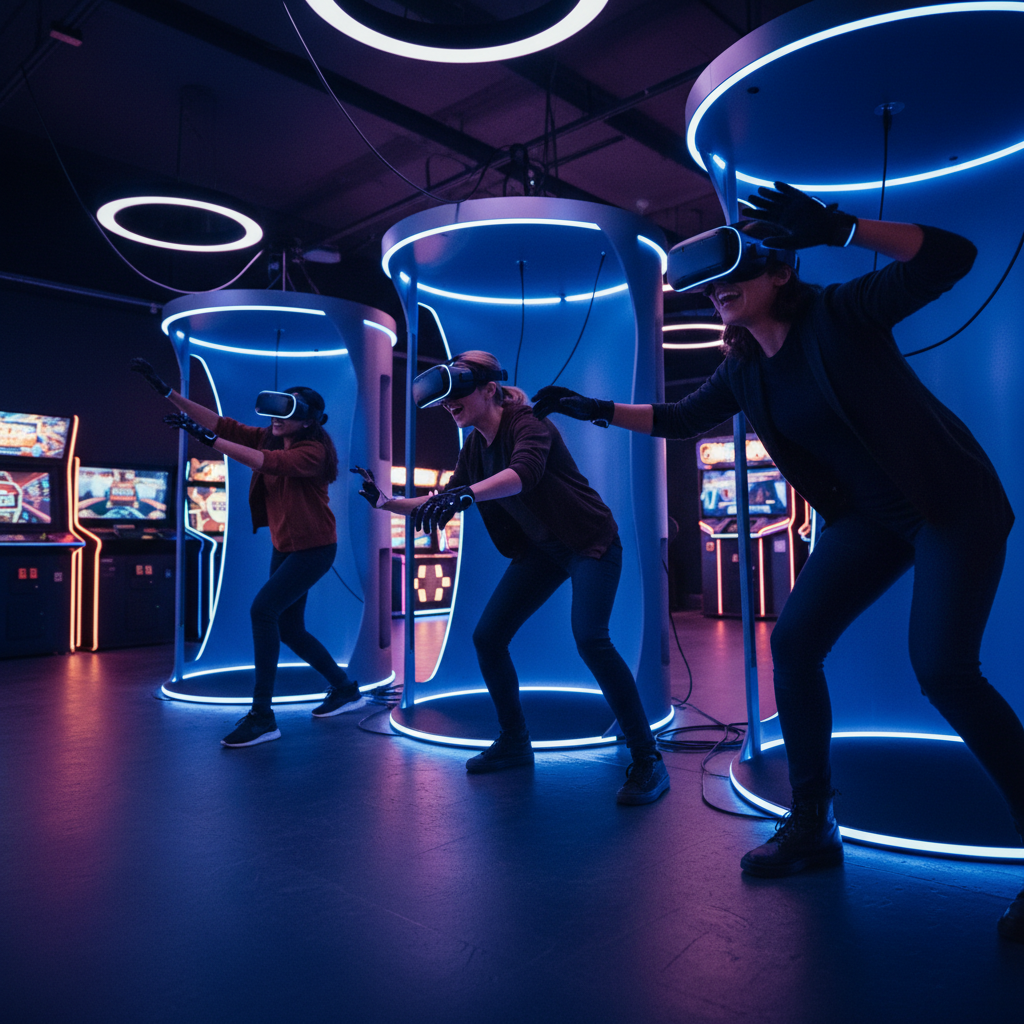
Case studies and real examples from London families
London families succeed fastest when they start with creative or rhythm games, then switch to co-op puzzles. In our 12 escape rooms, 1–6 players rotate roles—navigator, solver, and spotter—so kids as young as 7 contribute meaningfully while teens lead key challenges.
Birthday crew: ages 8–12
- Setup: 4 pods side-by-side for easy coaching and high-five moments.
- Flow: 10 minutes of creative play, 20 minutes of co-op mini-games, 10 minutes of a rhythm favorite.
- Outcome: Smiling group photos on the party room TVs; kids ask to try “the puzzle one” next time.
Sibling duo: ages 10 and 15
- Setup: Navigator (younger) and Solver (older) split tasks; parents coach from TV.
- Flow: Start in a tutorial world, then move to light puzzle challenges.
- Outcome: The 10-year-old learns snap-turn and teleports with confidence in under 15 minutes.
Family of five: adults + teens
- Setup: 5 adjacent pods; one parent uses seated mode and directs from the spectator screen.
- Flow: Rhythm warm-up, escape room, then friendly sports challenge.
- Outcome: Everyone contributes; teens handle precision tasks, parents track clues and time.
Want a low-wait-time plan? Use our 30-minute session guide to structure fast rotations and a satisfying “finale” game.
Safety, comfort, and accessibility
Comfort-first settings, staff supervision, and room-scale boundaries help families play safely. We recommend short rounds, hydration breaks, and seated options for newcomers. Our staff configures teleport, snap-turn, and vignette to minimize motion discomfort.
- Boundaries: Our room-scale setup keeps players in safe zones with visible guardian lines.
- Hygiene: Headsets and controllers are sanitized between sessions; disposable covers available upon request.
- Breaks: Two-minute water-and-stretch resets restore focus faster than powering through.
- Accessibility: Seated play modes and adjustable heights support a wide range of needs.
- Parent oversight: Spectator screens let adults coach and supervise without wearing a headset.
When to choose a VR escape room
Pick a VR escape room when your group wants structured teamwork, clear objectives, and 1–6 player roles. With built-in hint systems and staff support, escape rooms give families a shared mission that scales for mixed ages.
Escape rooms shine when you have varying skill levels. They offer a sequence of bite-size puzzles, visual clues, and time targets that keep energy high. Families often set a “clue captain” and a “timer,” then rotate the headset so everyone gets to lead at least once.
- Great for: Birthdays, cousins visiting from out of town, or school-friend meetups.
- What you’ll practice: Communication, pattern recognition, and task switching.
- Pro move: Read our strategies for VR escape room clues to get unstuck faster.
Planning for birthdays, school groups, and teams
For birthdays and school groups, combine adjacent pods with our private party room. Use a run-of-show agenda, rotate every 10–15 minutes, and end with a high-energy game. Staff help you match content to ages and keep groups moving smoothly.
- Birthdays: Balance creative, co-op, and rhythm so every guest finds a win. For ideas, see VR birthday party tips.
- School visits: Bring a subject tie-in; our educational VR catalog includes history, science, and art.
- Corporate team-building: Use puzzle adventures to practice communication; see our team-building guide.
Need help matching titles to your audience? Chat with our staff when you arrive, or explore our VR arcade overview to preview pods and experiences.
Plan your visit (soft CTA)
Have questions about ages, genres, or session flow? Our team can recommend a family friendly VR lineup in minutes. Visit our VR arcade overview to see pods, party room details, and escape rooms, then plan your ideal lineup.
Want help choosing games for mixed ages? Our London team does this all day. Stop by to ask for recommendations, or explore the VR arcade overview and educational experiences pages for ideas before you arrive.
Frequently Asked Questions
Families ask about ages, game choices, comfort settings, and session length. The short answer: start simple, rotate often, and lean on our staff for setup and recommendations. Here are fast answers to common questions.
What makes a VR game “family friendly”?
It uses age-appropriate content, forgiving difficulty, and comfort-first movement like teleport or snap-turn. Clear tutorials, co-op options, and short objectives help kids, teens, and adults learn fast and play together.
How long should kids play in a single session?
Plan 10–15 minute rounds within a 30–60 minute session. Short, focused bursts keep energy high and make it easy to switch roles so everyone stays involved and comfortable.
What if someone feels motion discomfort?
Pause immediately, switch to seated mode, and enable teleport, snap-turn, and vignette. Try a creative or rhythm title next. Our staff can re-check fit and boundaries to improve comfort.
Can mixed ages really play together?
Yes. Co-op puzzles, rhythm rotations, and party mini-games let everyone contribute. We often assign roles—navigator, solver, and spotter—so even spectators help the team succeed.
When should we choose a VR escape room?
Choose an escape room when you want a shared mission with clear objectives for 1–6 players. Built-in hint systems and staff support help families with varied experience levels collaborate smoothly.
Key takeaways
Choose gentle, co-op-heavy games; enable comfort options; keep rounds short; and rotate roles. At The Next Level, 22 pods, 12 escape rooms, and staff support make family friendly VR easy to learn, safe to enjoy, and memorable for all ages.
- Start with creative, puzzle, rhythm, or light sports—great first steps for all ages.
- Use teleport, snap-turn, vignette, and seated modes to boost comfort.
- Rotate every 10–15 minutes and celebrate shared wins, not just scores.
- Leverage staff and spectator TVs to coach, cheer, and include everyone.
- Try a VR escape room when you want structured teamwork for 1–6 players.
Ready to play? Explore our VR arcade overview and drop in with your family. We’ll help you pick the perfect first game and get everyone smiling in minutes.